

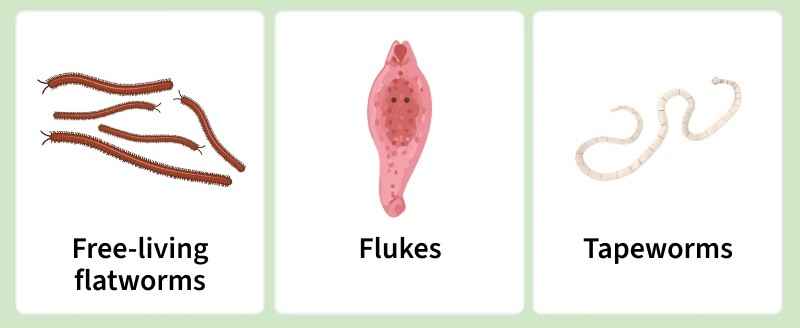
Phylum Platyhelminthes includes soft-bodied, unsegmented invertebrates commonly known as flatworms due to their dorsoventrally flattened bodies. They are among the simplest bilaterally symmetrical, triploblastic animals and are mostly acoelomate in nature. Members of this phylum occur in freshwater, marine, terrestrial, and parasitic habitats. Some species are free-living, while others are parasites that can cause diseases in humans and animals.
General Characteristics of Phylum Platyhelminthes
- They are bilaterally symmetrical animals, meaning the body can be divided into two halves along a single plane.
- They are triploblastic organisms because their bodies develop from three embryonic germ layers are ectoderm, mesoderm, and endoderm
- They are acoelomates and therefore lack a true body cavity.
- Their bodies are dorsoventrally flattened, giving them a ribbon-like or leaf-like appearance.
- They exhibit organ-level organisation.
- The body is soft, elongated, and unsegmented.
- Both free-living and parasitic forms occur within the phylum.
- Most species possess an incomplete digestive system with a mouth but no anus.
- Tapeworms completely lack a digestive system and absorb nutrients directly through their body surface.
- Circulatory and respiratory systems are absent.
- Exchange of gases occurs through simple diffusion across the body surface.
- Excretion and osmoregulation are carried out by specialised flame cells that form a protonephridial system.
- The nervous system consists of paired cerebral ganglia connected to longitudinal nerve cords, forming a ladder-like arrangement.
- Most members are hermaphrodites, possessing both male and female reproductive organs in the same individual.
- Fertilisation is usually internal.
- Reproduction may occur both sexually and asexually.
- Many species possess remarkable regenerative abilities.
Unique Features of Platyhelminthes
- Several characteristics distinguish Platyhelminthes from other animal phyla.
- One of the most distinctive features is the presence of flame cells, which function in excretion and osmoregulation. These specialised cells contain bundles of cilia that create currents for the removal of waste products and excess water.
- Another important feature is the ladder-like nervous system, which consists of paired longitudinal nerve cords connected by transverse commissures.
- Platyhelminthes are also among the simplest animals to exhibit bilateral symmetry and cephalization, a condition in which sensory structures and nervous tissues become concentrated at the anterior end of the body.
- Their exceptional regenerative capacity is particularly well developed in free-living forms such as Planaria, which can regenerate an entire organism from small body fragments.
Examples of Platyhelminthes
- Planaria (Dugesia): Planaria is a free-living freshwater flatworm famous for its extraordinary regenerative capacity. Even small body fragments can regenerate into complete organisms.
- Fasciola hepatica: Commonly known as the liver fluke, this parasite inhabits the liver and bile ducts of sheep, cattle, and other mammals.
- Schistosoma: Schistosoma is commonly known as the blood fluke and causes the disease schistosomiasis in humans. It is one of the most medically important parasitic flatworms.
- Taenia solium: This organism, commonly known as the pork tapeworm, infects humans through the consumption of undercooked pork containing larval cysts. It causes taeniasis and may also lead to cysticercosis.
- Echinococcus granulosus: This small tapeworm causes hydatid disease in humans and other mammals. Dogs serve as the primary host in their life cycle.
Importance of Platyhelminthes
- Platyhelminthes possess both beneficial and harmful significance.
- Free-living flatworms contribute to ecosystem balance by feeding on organic matter and small organisms.
- They also serve as important model organisms in biological research, particularly in studies of regeneration and stem cell biology.
- Many parasitic species, however, are responsible for serious diseases in humans and domesticated animals.
- Diseases such as taeniasis, cysticercosis, schistosomiasis, and hydatid disease cause significant health problems and economic losses worldwide.