

Phylum Echinodermata is an important group of marine animals that includes some of the most unique and interesting organisms found in the animal kingdom. The word “Echinodermata” is derived from two Greek words: echinos, meaning “spiny”, and derma, meaning “skin.” Therefore, echinoderms are commonly referred to as “spiny-skinned animals.”
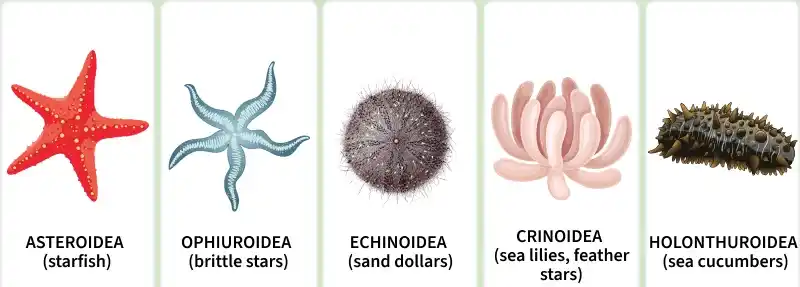
Members of this phylum are exclusively marine and are found in oceans worldwide, ranging from shallow coastal waters to deep-sea environments. Starfish, sea urchins, brittle stars, sea cucumbers, and feather stars are common examples of echinoderms.
General Characteristics of Phylum Echinodermata
Echinoderms possess several characteristic features that distinguish them from other animal groups.
1. Habitat and Distribution
- All echinoderms are marine animals and cannot survive in freshwater or terrestrial habitats.
- They are widely distributed in oceans across the world and are commonly found on the sea floor. Some echinoderms live attached to rocks, while others crawl slowly over the ocean bed.
- Certain species are adapted to deep-sea conditions where sunlight does not penetrate.
- Starfish are commonly found in shallow coastal waters, while sea cucumbers and sea urchins may inhabit deeper regions. Feather stars are often attached to corals or rocks in marine ecosystems.
2. Body Organisation and Symmetry
- Echinoderms show a unique type of symmetry during different stages of their life cycle.
- The larval forms are bilaterally symmetrical, whereas adult forms exhibit radial symmetry, particularly pentaradial symmetry in which body parts are arranged in multiples of five around a central axis.
- The body may be divided into the central disc, Arms or rays, Oral surface, and Aboral surface.
3. Body Wall and Endoskeleton
- The body wall of echinoderms consists of Epidermis, Dermis, and Coelomic epithelium.
- The dermis contains calcareous plates or ossicles that form an internal skeleton or endoskeleton.
- These ossicles may bear spines that project outward through the skin, giving the body a rough or spiny appearance.
- In some echinoderms, such as sea urchins, the ossicles are fused to form a rigid shell called a test.
- In sea cucumbers, the skeleton is greatly reduced.
4. Water Vascular System
The water vascular system is the most characteristic and distinctive feature of echinoderms. It is a complex network of fluid-filled canals used for locomotion, feeding, respiration, and sensory functions. The water vascular system mainly consists of:
- Madreporite: The madreporite is a sieve-like plate present on the aboral surface through which seawater enters the water vascular system.
- Stone Canal: The stone canal connects the madreporite to the ring canal.
- Ring Canal and Radial Canals: The ring canal surrounds the mouth and gives rise to radial canals extending into the arms.
- Tube Feet: Tube feet or podia are small tubular projections attached to radial canals. These structures facilitate movement, attachment, food capture, and gaseous exchange. The movement of tube feet is controlled hydraulically by changes in water pressure inside the canals.
5. Digestive System
- The digestive system of echinoderms is usually complete with a mouth, digestive tract, and anus.
- In starfish, the mouth is located on the oral surface, and the anus is present on the aboral surface.
- Some echinoderms are carnivorous, while others are herbivorous or detritivorous.
- Starfish feed mainly on molluscs and possess the remarkable ability to evert their stomach outside the body to digest food externally.
- Sea cucumbers feed on organic matter present in sand and mud.
6. Respiration
- Respiration in echinoderms occurs through different structures depending on the species.
- Oxygen diffuses directly through these structures into body fluids.
- In starfish, respiration occurs through papulae and tube feet.
- In sea urchins, gaseous exchange occurs through tube feet and gills.
- In sea cucumbers, respiration takes place through respiratory trees.
- In brittle stars, respiration occurs through bursae.
7. Circulatory System
A true circulatory system is absent in echinoderms. The transport of nutrients and gases mainly occurs through the coelomic fluid and the water vascular system.
8. Excretory System
Specialised excretory organs are absent in echinoderms. Nitrogenous wastes mainly diffuse out through tube feet and respiratory surfaces.
9. Nervous System
- The nervous system of echinoderms is simple and poorly developed.
- It mainly consists of a nerve ring around the mouth and radial nerves extending into the arms.
- Sense organs are not highly developed, but sensory cells sensitive to touch, chemicals, and light are present. Some echinoderms possess eye spots at the tips of arms.
10. Reproduction in Echinoderms
Most echinoderms reproduce sexually and are dioecious, meaning sexes are separate.
- Sexual Reproduction: Male and female gonads release gametes into seawater, where fertilisation occurs externally. The fertilised egg develops into a free-swimming larva.
- Larval Forms: Different echinoderms possess different larval stages such as Bipinnaria larva, Brachiolaria larva, Echinopluteus larva, and Auricularia larva. Larvae are bilaterally symmetrical and undergo metamorphosis to form radially symmetrical adults.
- Asexual Reproduction and Regeneration: Some echinoderms reproduce asexually through fragmentation and regeneration. Starfish possess extraordinary regenerative ability and can regenerate lost arms or even entire bodies from body fragments.
Economic Importance of Echinoderms
- They form an important part of marine food chains.
- Sea cucumbers are used as food in some countries.
- Sea urchin eggs are consumed as delicacies.
- Some echinoderms help clean ocean floors by feeding on dead organic matter.
- Certain species are used in biological and developmental studies.