

The monocot root is the root system found in monocotyledonous plants, whose seeds contain a single cotyledon. It typically forms a fibrous root system consisting of numerous adventitious roots of similar size that arise from the base of the stem. Monocot roots help in the absorption of water and minerals and provide firm anchorage to the plant. They are characterised by a polyarch vascular arrangement, a large central pith, and the absence of secondary growth.
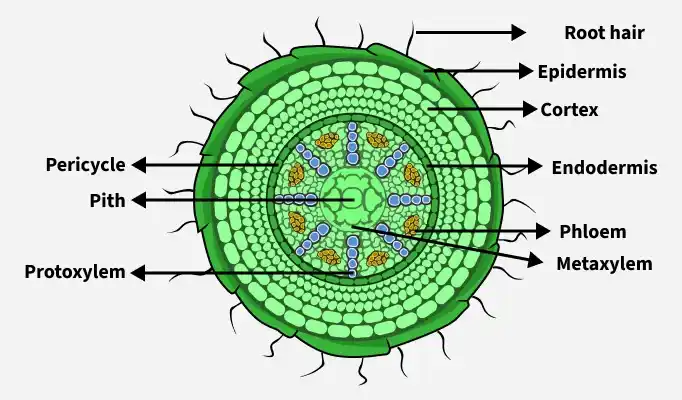
Structure of Monocot Root
When a transverse section of a monocot root is examined under a microscope, several distinct regions can be observed. These regions are arranged from the outermost layer toward the centre and include the epiblema, cortex, endodermis, pericycle, vascular tissues, and pith.
Epiblema (Piliferous Layer)
- The epiblema is the outermost protective layer of the monocot root. It consists of a single layer of thin-walled, living, parenchymatous cells that are closely packed together without intercellular spaces.
- The cells are usually colourless and polygonal in shape.
- The epiblema bears numerous unicellular root hairs that greatly increase the surface area available for the absorption of water and mineral salts from the soil.
- Because of the presence of root hairs, this layer is also known as the piliferous layer or rhizodermis. Unlike the epidermis of stems and leaves, the epiblema does not possess a cuticle because the presence of a waterproof covering would interfere with water absorption.
- Stomata are also absent in this layer because roots are not involved in gaseous exchange to the same extent as aerial plant parts.
Cortex
- Beneath the epidermis lies the cortex, which forms a major portion of the root. The cortex consists of many layers of thin-walled parenchymatous cells with prominent intercellular spaces.
- These cells serve as storage tissues and store food materials and water for the plant.
- The cortex allows the easy movement of water and dissolved minerals from the root hairs toward the inner vascular tissues.
- In mature roots, the outermost cortical layer may become differentiated into an exodermis that provides additional protection to the root.
Endodermis
- The innermost layer of the cortex is called the endodermis.
- It consists of a single layer of compactly arranged barrel-shaped cells that lack intercellular spaces.
- The endodermis serves as a selective barrier regulating the movement of water and dissolved substances into the vascular tissues.
- The radial and transverse walls of the endodermal cells possess thickened bands known as Casparian strips, which are composed of suberin and lignin.
- These strips prevent the uncontrolled movement of water through cell walls and ensure that water enters the vascular tissues through the living cells of the endodermis.
- Certain endodermal cells located opposite the protoxylem remain thin-walled and are known as passage cells. These cells facilitate the movement of water and mineral ions into the vascular cylinder.
Stele
The central region enclosed by the endodermis is known as the stele or vascular cylinder. It consists of the pericycle, vascular tissues, and pith.
Pericycle
- The pericycle is situated immediately below the endodermis and forms the outermost layer of the stele.
- It generally consists of a single layer of parenchymatous cells.
- The pericycle plays an important role in the formation of lateral roots. Unlike dicot roots, monocot roots do not undergo secondary growth; therefore, the pericycle does not contribute to the formation of vascular cambium or cork cambium.
Vascular Tissues
- The vascular tissues consist of xylem and phloem arranged alternately on different radii, a condition known as a radial vascular bundle.
- The xylem is responsible for conducting water and minerals from the roots to the aerial parts of the plant, whereas the phloem transports organic food materials throughout the plant body.
- In monocot roots, the xylem shows an exarch condition, in which the protoxylem is located toward the periphery, and the metaxylem is situated toward the centre.
- Usually, more than six xylem bundles are present, and therefore, the vascular arrangement is described as polyarch. The metaxylem vessels are generally large and circular or oval in shape.
Pith
- The central portion of the monocot root is occupied by a large and well-developed pith.
- The pith consists of thin-walled parenchymatous cells that may contain intercellular spaces.
- These cells often serve as storage tissues and contribute to the overall structural organisation of the root.
- The presence of a large pith is one of the most important features that distinguishes monocot roots from dicot roots, where the pith is usually very small or absent.
Characteristics of Monocot Roots
- The root system is fibrous and consists of numerous adventitious roots arising from the base of the stem.
- The epiblema is composed of thin-walled living cells and bears unicellular root hairs.
- Cuticle and stomata are absent from the epiblema.
- The cortex is broad and composed of many layers of parenchymatous cells.
- The endodermis possesses Casparian strips and passage cells.
- The pericycle is generally single-layered and parenchymatous.
- The vascular bundles are radial in arrangement.
- Xylem is exarch in nature.
- More than six xylem bundles are present, resulting in a polyarch condition.
- A large and well-developed pith is present at the centre.
- Secondary growth is absent.
- The root primarily functions in absorption, conduction, storage, and anchorage.
Functions of Monocot Root
- The root hairs absorb water and dissolved mineral nutrients from the soil and transport them to the aerial parts of the plant.
- The fibrous root system firmly anchors the plant in the soil and prevents it from being uprooted by wind or other environmental factors.
- The vascular tissues conduct water, minerals, and food substances throughout the plant body.
- Certain monocot roots store food and water, which can be utilised by the plant during unfavourable environmental conditions.
- The extensive network of fibrous roots binds soil particles together and helps reduce soil erosion.