

Flowering plants are really characterized into two classes in light of their undeveloped organism, called monocotyledonous (monocot) plants and dicotyledonous plants.
- The internal structure (anatomy) of stems differs in monocotyledonous and dicotyledonous plants.
- These differences are mainly seen in the arrangement of vascular bundles, the presence of cambium, and secondary growth.
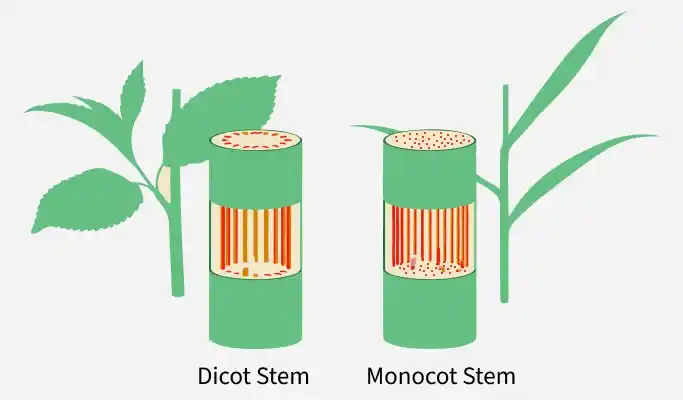
Dicotyledonous Stems
The dicotyledons, otherwise called dicots, are one of the two groups into which all flowering plants were previously isolated. The name alludes to one of the average qualities of the gathering: specifically, that the seed has two early-stage leaves or cotyledons.
Examples of dicotyledonous plants: tomatoes, cauliflower, beans, apples, potatoes, and so forth.
Characteristics of Dicotyledonous Stem
- Stems are normally strong.
- Cambium is available.
- The quantity of xylem and phloem is two to four, and they are recognized by a layer of parenchymatous cells called conjunctive tissue.
- Vascular groups in the stem are less organized around and around or in a ring.
- Essence is obvious as it is comprised of palisade cells.
- The pack sheath is missing around the vascular groups.
- The pericycle is available.
- Phloem parenchyma and phloem strands are available.
Anatomy of Dicotyledonous Stem
The dicot stem develops from the plumule of the embryo and forms the main axis of dicotyledonous plants. The anatomy of a dicot stem is characterized by a well-differentiated internal structure consisting of epidermis, cortex, endodermis, pericycle, vascular bundles, and pith.
The internal tissue organization of a dicotyledonous stem is as follows:
- The epidermis forms the protective outer layer of the stem and is covered with a thin layer of cuticle.
- It consists of trichomes (hair-like structures) and a few stomata for gas exchange.
- Multiple layers between the epidermis and the pericycle constitute the cortex. It consists of three sub-zones:
- Outer hypodermis: Consists of a few layers of collenchymatous cells just below the epidermis and provides mechanical strength to the young stem.
- Middle parenchymatous cells: It consists of round, thin-walled parenchymatous cells with small intercellular spaces.
- Endodermis (Starch Sheath): It is the innermost layer of the cortex, and cells are rich in starch grains, also called the starch sheath.
- Pericycle is present on the inner side of the endodermis and above the phloem in the form of semi-lunar patches of sclerenchyma.
- A medullary ray is present between the vascular bundles, which consists of radially placed parenchymatous cells.
- Vascular bundles are arranged in a "ring," which is the main characteristic of a dicot stem. Vascular bundles are conjoint, open, and have endarch protoxylem.
- Pith forms the central portion of the stem and consists of a large number of rounded, parenchymatous cells with large intercellular spaces. It provides structural support and storage.
Monocotyledonous Stems
Monocotyledons, regularly referred to as monocots, are grass-like flowering plants, the seeds of which normally contain just a single early-stage leaf or cotyledon.
Examples of monocotyledonous (monocot) plants are maize, corn, grass, and wheat.
Characteristics of Monocotyledonous Stem
- No cambium, thus no auxiliary development in the stem.
- The stem is generally empty.
- Vascular groups in the stem are dispersed and various.
- Phloem parenchyma is missing.
- Essence is missing.
- Vascular groups are encircled by a sclerenchymatous pack sheath.
- The pericycle is missing.
Anatomy of Monocotyledonous Stem
The monocot stem develops from the plumule of the embryo and forms the main supporting axis of monocotyledonous plants. The anatomy of a monocot stem is characterized by a single-layered epidermis, a sclerenchymatous hypodermis, and an undifferentiated ground tissue.
The internal tissue organization of a monocotyledonous stem is as follows:
- A monocot consists of a sclerenchymatous hypodermis below the epidermis for mechanical strength.
- There are numerous vascular bundles scattered throughout the stem. Each vascular bundle is surrounded by a sclerenchymatous bundle sheath.
- Vascular bundles are conjoint and closed. Peripheral vascular bundles are generally smaller than the centrally located ones.
- Phloem parenchyma is absent in the vascular bundles.
- Water-containing cavities are present within the vascular bundles.