

Mendel crossed two homozygous plants that differed in a single trait to produce heterozygous offspring. This type of cross is known as a monohybrid cross and involves the inheritance of a single gene or characteristic. Different forms of a gene controlling the same trait are called alleles.
A monohybrid cross helps in understanding the inheritance pattern of a single trait and demonstrates Mendel’s law of dominance.

After the monohybrid cross, the heterozygous offspring obtained are called the first filial generation (F1 generation).
- When the F1 plants are self-pollinated between F1 progeny or a heterozygous trait, the resulting progeny is called the F2 generation.
- Three-fourths of the offspring show the dominant trait, while one-fourth show the recessive trait.
- The genotypic ratio obtained is 1 homozygous dominant: 2 heterozygous: 1 homozygous recessive.
Mendel's Laws of Inheritance
The three laws of inheritance are:
- Law of Segregation: This law states that each organism possesses two copies (alleles) of each gene, one inherited from each parent, meaning that each parent contributes one allele for a trait to the offspring.
- Law of independent assortment: This law states that genes for different traits are passed down separately from each other.
- Law of dominance: This law states that one allele may mask the expression of another allele.
Overall, these rules help us understand how we inherit traits from our parents, and why we look similar or different from them.
How to carry out a Monohybrid cross?
The monohybrid cross is carried out by carrying out the following steps:
- Select two parent organisms with differing traits controlled by a single gene.
- Ensure one parent is homozygous dominant, and the other is homozygous recessive for that gene.
- Cross the parents, allowing for controlled pollination or mating.
- Observe the offspring (F1 generation), which will all be heterozygous for that gene.
- Allow the F1 generation to self-pollinate.
- Observe the F2 generation to determine the phenotypic ratios.
- Analyse the data and compare the observed ratios to Mendel's principles of inheritance.

We can understand this concept through one of Mendel's experiments, where he crossed tall and dwarf pea plants to study the inheritance of one gene.
- 1st Generation - In the first generation, Mendel crossed a pure tall pea plant with a pure dwarf pea plant.
- 2nd Generation - In the next experiment, He self-pollinated the F1 tall plants.
Based on these observations, he proposed that both genes are passed down to generations in the form of alleles. He called these things ‘factors’. Now we call them genes. When two parents are not similar, one of the gene traits is dominant while the other is recessive in a child.
Example of Monohybrid Cross
Example of a monohybrid cross using pea plants with purple (P) and white (p) flower colour as the trait is as follows:
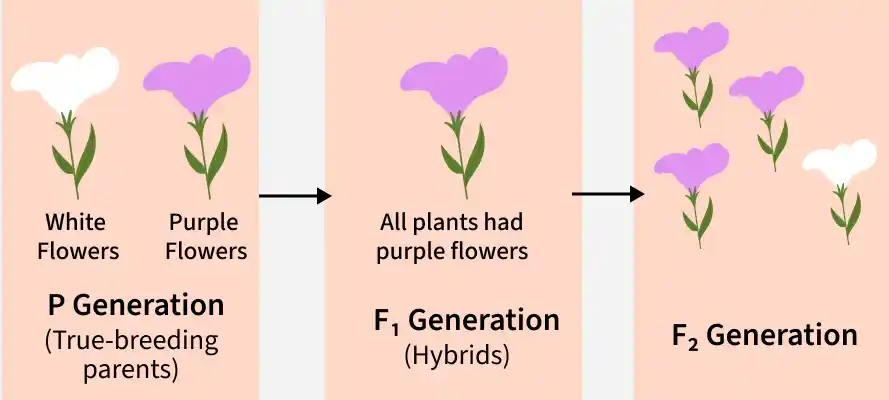
Parental Generation (P):
- One parent has purple flowers (PP, homozygous dominant).
- The other parent has white flowers (pp, homozygous recessive).
F1 Generation:
- Cross the two parents.
- All the offspring in the F1 generation will have purple flowers (Pp, heterozygous).
F2 Generation:
- Allow the F1 generation to self-pollinate or cross-pollinate.
- Observe the offspring in the F2 generation.
- 3:1 phenotypic ratio
- Three-fourths (75%) will have purple flowers (PP or Pp).
- One-fourth (25%) will have white flowers (pp).
This monohybrid cross demonstrates Mendel's law of dominance, where the dominant trait (purple flowers) masks the expression of the recessive trait (white flowers) in the F1 generation, but the recessive trait reappears in the F2 generation in a 3:1 ratio.