

Apomixis and polyembryony are two important phenomena observed in plants that involve unusual methods of reproduction and embryo formation. These processes are significant in plant breeding, agriculture, and horticulture because they help in producing genetically similar plants and improving crop quality.
Apomixis
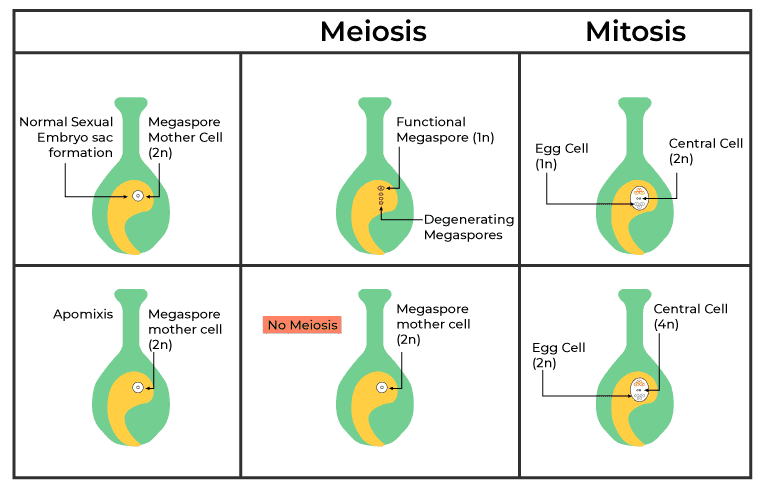
Apomixis is a type of asexual reproduction in which seeds are produced without the fusion of male and female gametes. Since fertilization does not occur, the offspring produced are genetically identical to the parent plant. The seeds formed through apomixis are called apomictic seeds.
Apomixis is the process of seed formation without fertilisation and meiosis. It is commonly found in some grasses and flowering plants.
Characteristics of Apomixis
The important characteristics of apomixis are:
- It is a form of asexual reproduction.
- Fertilisation is absent.
- Meiosis may be absent or incomplete.
- Offspring are genetically identical to the parent plant.
- It helps preserve desirable traits.
Types of Apomixis
Apomixis can be classified based on the following criteria:
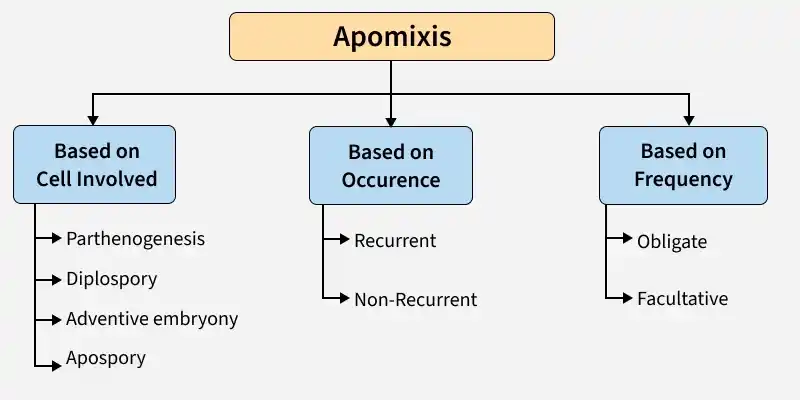
Types of Apomixis Based on Cell involved
- Parthenogenesis: In parthenogenesis, the embryo develops directly from the egg cell without fertilisation.
- Diplospory: In diplospory, the embryo sac develops from the megaspore mother cell without normal meiosis.
- Apospory: In apospory, the embryo sac develops from nucellar or somatic cells instead of the megaspore mother cell.
- Adventive Embryony: In adventive embryony, embryos develop directly from nucellus or integument cells.
Types of Apomixis Based on Occurrence
- Recurrent Apomixis: Recurrent apomixis is also known as gametophytic apomixis. In this type, the embryo sac develops from the megaspore mother cell without normal meiosis or through incomplete meiosis. As a result, the egg cell and embryo remain diploid.
- Non-Recurrent Apomixis: In non-recurrent apomixis, the embryo develops directly from a haploid egg cell without fertilisation. This process is called haploid parthenogenesis. Sometimes, embryos may also arise from other haploid cells of the embryo sac, a process known as haploid apogamy.
Types of Apomixis Based on Frequency
- Obligatory (Obligate) Apomixis: In obligate apomixis, reproduction always occurs through apomixis only. Sexual reproduction is completely absent.
- Facultative Apomixis: In facultative apomixis, both apomictic and sexual reproduction may occur in the same plant. There is no certainty whether offspring will develop through fertilisation or apomixis.
Polyembryony
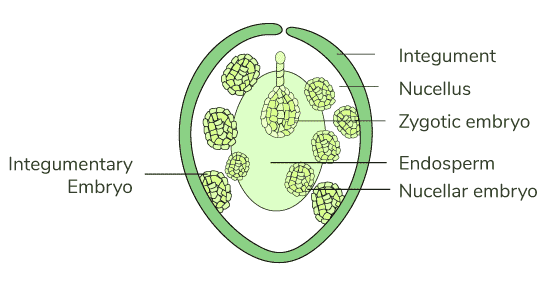
Polyembryony is the occurrence of more than one embryo inside a single seed. It is commonly found in certain flowering plants and gymnosperms.
Polyembryony is the development of two or more embryos from a single ovule or seed.
Causes of Polyembryony
Polyembryony may occur due to:
- Cleavage of zygote
- Development of embryos from nucellus cells
- Formation of embryos from synergids or antipodal cells
Types of Polyembryony
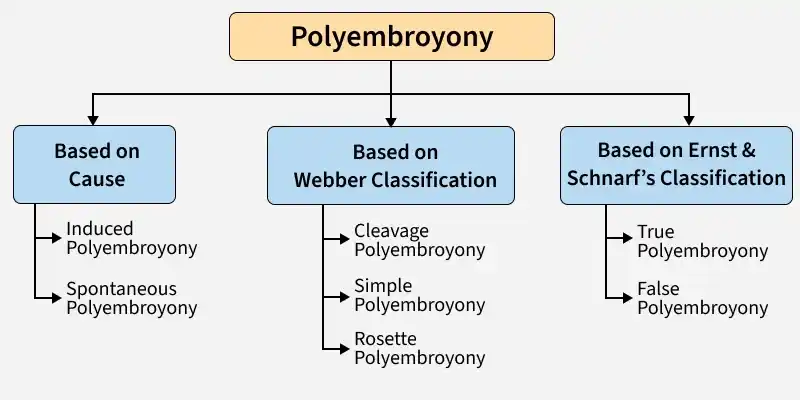
Polyembryony can be classified based on the following criteria:
Based on Ernst and Schnarf's Classification
- True Polyembryony: In true polyembryony, multiple embryos develop within the same ovule.
- False Polyembryony: In false polyembryony, embryos arise from different ovules but appear within the same seed or fruit.
Webber’s Classification of Polyembryony
- Cleavage Polyembryony: A single zygote divides into several embryos.
- Simple Polyembryony: Multiple embryos develop from different embryo sacs.
- Rosette Polyembryony: Embryos develop from rosette cells, mainly in gymnosperms.
Based on Cause
- Induced Polyembryony: This category contains situations in which polyembryony was caused through an experiment.
- Spontaneous Polyembryony: This refers to all instances of polyembryony that develop spontaneously.
Examples: Mango, Citrus, Onion, Gymnosperms