

Chromatin and chromosomes are two different structural forms of genetic material found in the nucleus of eukaryotic cells.
- Chromatin: A vital element of a cell's nucleus; it is essential for the storage, access, and control of genetic information. It is a complicated structure made up of DNA that has been wrapped up in unique proteins called histones.
- Chromosomes: Distinct, thread-like structures found in the nucleus, which become clearly visible during cell division. They play a crucial role in the organization, storage, and transmission of genetic information in all living organisms.
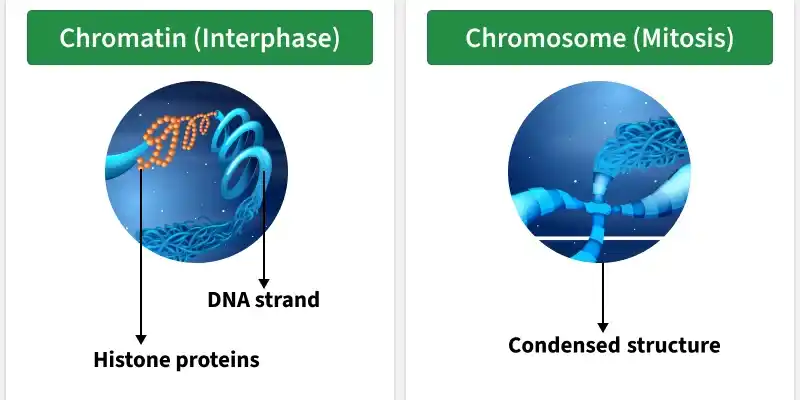
The difference between chromatin and chromosomes is as follows:
| Characteristics | Chromatin | Chromosome |
|---|---|---|
| Definition | A complex of DNA, RNA, and proteins (mainly histones) forming a loose structure | A highly condensed and compact form of chromatin |
| Presence | Present throughout the cell cycle | Clearly visible mainly during cell division. |
| Visibility | Not clearly visible under a light microscope (seen under an electron microscope) | Clearly visible under a Light microscope. |
| Appearance | Long, thin, thread-like and extended | Short, thick, and rod-shaped |
| Pairs | Does not exist as distinct pairs | Exists as homologous pairs (in diploid cells) |
| Function | Helps in gene expression and regulation | Helps in the storage and proper segregation of genetic material |
| Observable Stage | Seen during Interphase | Seen during M-phase (cell division) |
| DNA Packaging | Loosely packed, allowing Transcription. | Highly condensed, transcription is inactive |