

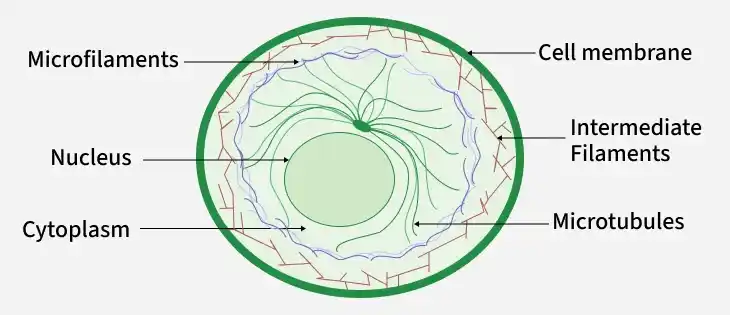
The cytoskeleton is a dynamic network of protein filaments present within the cytoplasm of eukaryotic cells. It provides structural support, maintains cell shape, and plays a key role in movement, transport, and cell division. Although once thought to be a static framework, the cytoskeleton is highly flexible and constantly reorganises according to the needs of the cell.
Characteristics of Cytoskeleton
The cytoskeleton is an interconnected system of protein fibres found in both prokaryotic and eukaryotic cells (though more developed in eukaryotes). It forms a dynamic framework that:
- It is found in both prokaryotic and eukaryotic cells, though it is more complex in eukaryotes.
- It forms a dynamic internal framework of the cell.
- It helps maintain the shape and mechanical strength of the cell.
- It organises and supports cell organelles.
- It assists in the intracellular transport of materials.
- It enables movement of the cell and its organelles.
- It can rapidly assemble and disassemble according to cellular requirements
Components of the Cytoskeleton
The cytoskeleton is mainly composed of three types of protein filaments:
1. Microfilaments (Actin Filaments)
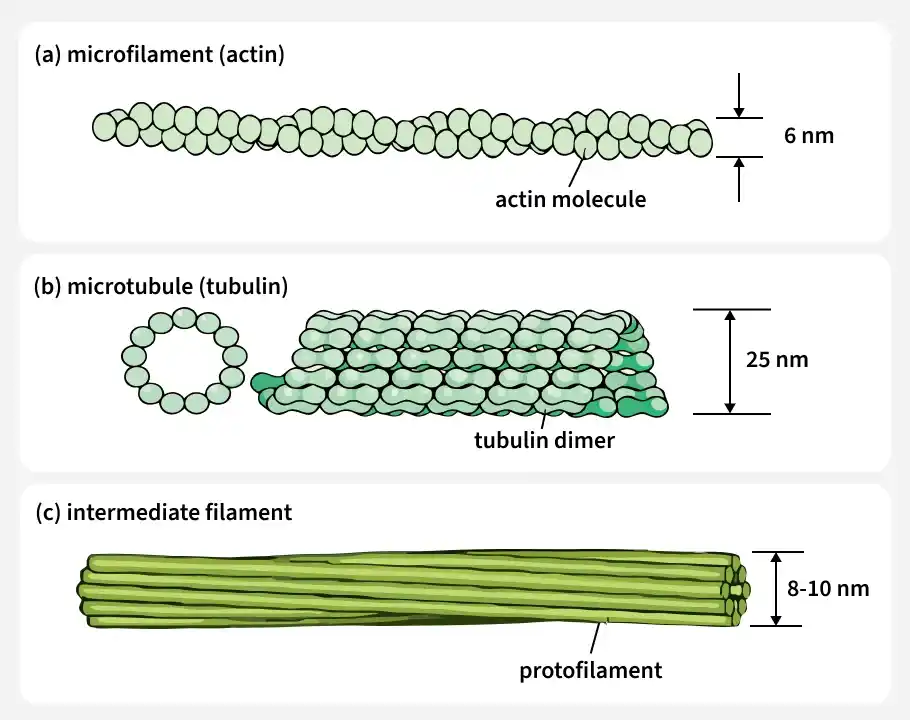
- Microfilaments are very thin, solid, and flexible fibres composed mainly of the protein actin.
- They are usually found just beneath the plasma membrane and form a supportive network that helps maintain the shape and flexibility of the cell.
- Microfilaments play an important role in cell movement and changes in cell shape.
- They are involved in activities such as amoeboid movement, muscle contraction, cytoplasmic streaming, and the formation of cellular projections.
2. Microtubules (Tubulin)
- Microtubules are the largest components of the cytoskeleton. They are long, hollow, cylindrical structures made up of a protein called tubulin.
- These structures originate from specialised regions within the cell and extend throughout the cytoplasm, forming an internal network.
- Microtubules help maintain the overall shape of the cell and provide pathways along which organelles and vesicles move from one part of the cell to another.
- They are important components of cilia and flagella and are essential during cell division, where they form spindle fibres responsible for chromosome movement.
3. Intermediate Filaments
- Intermediate filaments are medium-sized fibres that are stronger and more stable than microfilaments.
- They are composed of different types of proteins, such as keratin, depending on the type of cell.
- These filaments mainly provide mechanical support and structural stability to the cell.
- They help cells resist stress and maintain their shape, especially in tissues that experience stretching or pressure.
Functions of Cytoskeleton
- It maintains the shape and structural organisation of the cell.
- It provides mechanical support and strength to the cell.
- It anchors and positions organelles within the cytoplasm.
- It enables movement of cells, such as amoeboid movement and muscle contraction.
- It helps in the intracellular transport of materials and organelles.
- It forms structures such as cilia, flagella, and spindle fibres.
- It plays a major role in cell division by assisting in chromosome separation.
- It helps the cell adapt to changes in its environment through continuous reorganisation.