

Living organisms often interact with one another in various ways to survive and thrive in their environment. One such interaction is commensalism, where two species live in close association and only one of them benefits, while the other remains unaffected. This type of relationship is common in nature and plays a role in maintaining ecological balance and biodiversity.
Commensalism can be classified into different types based on how one organism benefits from another
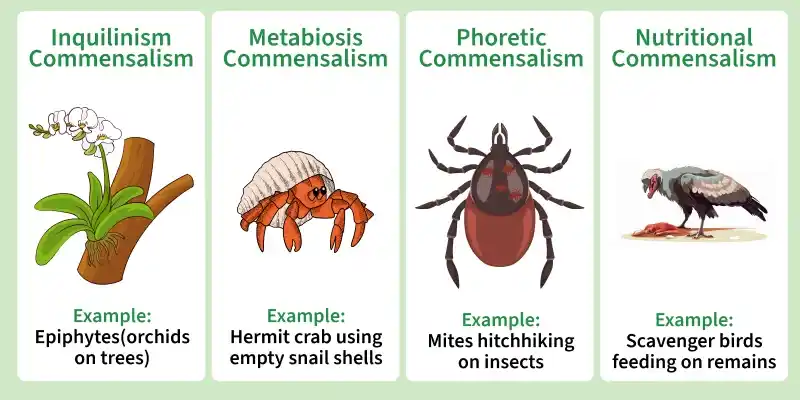
- Inquilinism: One organism lives on/in another for shelter without harming it. Example: Epiphytes (orchids on trees)
- Metabiosis: One organism depends on something created by another. Example: Hermit crab using empty snail shells
- Phoretic Commensalism: One organism uses another for transport. Example: Mites hitchhiking on insects
- Nutritional Commensalism: One organism feeds on the leftovers of another. Example: Scavenger birds feeding on remains
Characteristics
- Only one organism gains an advantage from the interaction.
- The other organism (host) is neither harmed nor benefited.
- The relationship can be short-term or long-lasting.
- Found in various ecosystems, including terrestrial and aquatic environments.
- The benefiting organism usually does not depend entirely on the host for survival.
Examples
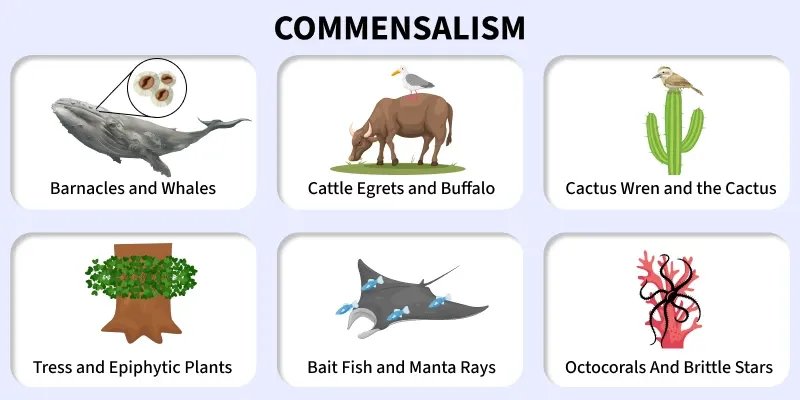
- Cattle and Cattle Egrets: Cattle egrets feed on insects disturbed by grazing cattle. Egret benefits; cattle are unaffected.
- Barnacles and Whales: Barnacles attach to whales and get transport and access to food. Barnacles benefit; whales are mostly unaffected.
- Orchids on Trees (Epiphytes): Orchids grow on trees for support. Orchid benefits, tree unaffected.
Importance
- Helps organisms find food and shelter
- Supports biodiversity
- Maintains ecological balance
- Promotes species coexistence