

Amphibia is a class of cold-blooded vertebrate animals that can live on both land and underwater. Amphibia are found in diverse areas like deserts, rainforests, mountains, and woodlands. They are considered to be crucial for the maintenance of the life cycle of the ecosystem, as these are insect predators.
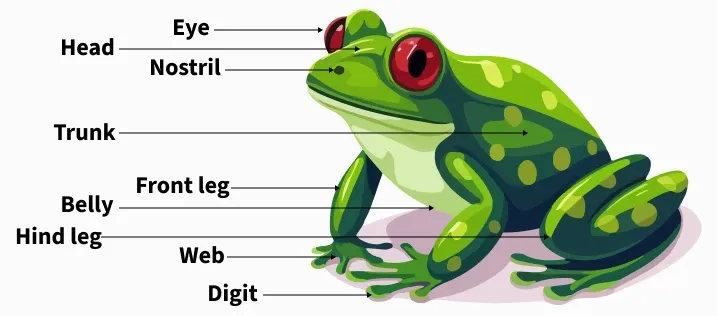
- They belong to the kingdom Animalia and phylum Chordata.
- Amphibians undergo a process known as metamorphosis that involves two distinct life phases.
- The first is the larval stage, during which they have gills and can only survive in water, and the second is the terrestrial stage, during which adults have lungs.
Characteristics of Class Amphibia
Amphibia are cold-blooded vertebrates and have several characteristic features.
- Moist Skin: They have thin and moist skin, which makes them able to breathe through their skin as well. Their skin allows them to exchange gases.
- Metamorphosis: It is a crucial feature of amphibians that makes them change from aquatic tadpole to terrestrial adult.
- Dual Respiration: Amphibians have a dual respiratory system, including lungs and cutaneous skin, while tadpoles have gills.
- Ectothermic: They are not capable of regulating their body temperature from inside; instead that their body temperature depends upon the surrounding environment.
- Heart: They have a three-chambered heart, including one ventricle and two atria.
- Larvae stage: All amphibians have a dual life, first as larvae, then as terrestrial adults.
- Amphibious: They can survive in water as well as on terrestrial, but they do require water for the reproductive cycle.
- External Fertilisation: Basically, female amphibians lay eggs outside their bodies, and male amphibians have to pour their sperm over the eggs to fertilise them.
- Aestivation and Hibernation: Amphibia can undergo estivation in hot weather and hibernation in cold weather to protect themselves in extreme conditions.
- Carnivorous: They are carnivorous in nature, i.e., feed on insects.
Classification of Class Amphibia
Class Amphibia is divided into Gymnophiona, Urodela, and Anura, representing different adaptations to aquatic and terrestrial life. These groups show diversity in structure, habitat, and mode of locomotion.
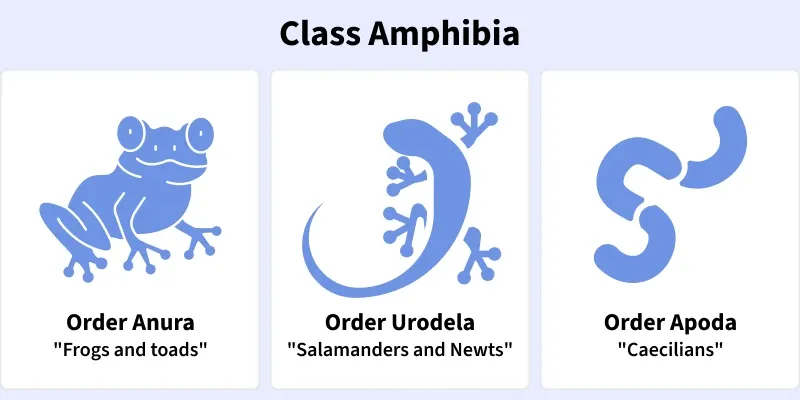
The class Amphibia are further divided into three sub-categories, which are as follows:
1. Order: Anura
- They do not have tails as a adult
- They have strong vocalisation
- They have four strong limbs to jump
- Fertilisation occurs outside the body
- Examples: Frogs and toads
2. Order Caudata
- They have tails throughout their lives
- They have four legs
- Their skin is rough
- They can regenerate their body parts, including limbs
- Examples: Salamanders and newts
3. Order: Gymnophiona or Apoda
- They do not have legs
- Appearance is like a snake or a worm
- Segmented
- They are found below the surface
- They can secrete mucus to reduce water
- Examples: Caecilians
Anatomy and Physiology of Class Amphibia
Amphibia have unique anatomy and physiology because they live in water as well as on the terrestrial surface.
Anatomical Features
- Skin: Amphibian skin is soft, moist because they secrete mucus, and they also exchange gases through their skin.
- Skeleton: They are vertebrates means they have bones in their body and have limbs.
- Muscular system: They have powerful hind limbs that allow them to jump.
- Respiratory system: They have two lungs and gills to respire. Tadpoles have gills while adults exchange gases through lungs and skin.
- Cardiac system: Their heart is three-chambered and has two atria and one ventricle.
- Digestive system: They have a two-chambered stomach, which allows them to store food and have a simple digestive system.
- Excretory system: They excrete through the kidneys, and the excreted waste mainly comprises urea.
- Reproduction: They mostly do external fertilisation of eggs.
Physiological Features
- Thermoregulation: Amphibians are ectothermic means they can not regulate temperature from the inside.
- Metamorphosis: They can transform themselves from the aquatic larval stage to the terrestrial adult stage.
- Circulation: They have three three-chambered hearts, unlike mammals have four four-chambered hearts.
- Nervous system: Their nervous system is simple and has a brain and a spinal cord.
- Sensory organs: The ear and eyes sense the surrounding environment.
- Defence mechanisms: They possess poison glands in their skin through which they can secrete poison to kill predators. They can change their skin colour to camouflage.