

Anthropic offers different AI models designed for different types of tasks. Some models focus on speed and affordability, while others are built for complex reasoning and autonomous AI agents. Choosing the right model depends on your application's requirements.
As of mid-2026, Anthropic maintains five active models across four tiers.
- Haiku 4.5: The fastest and most affordable Anthropic model. It is ideal for tasks such as text classification, information extraction, quick lookups, and processing large volumes of requests.
- Sonnet 5: The default model for Claude Free and Claude Pro users. It provides a good balance of speed, cost, and performance, making it suitable for coding, content writing, research, and everyday AI tasks.
- Opus 4.8: A high-performance model designed for complex tasks that require deep reasoning. It works well for debugging large codebases, analyzing lengthy documents, and solving challenging problems, although it is more expensive than Sonnet.
- Fable 5: Anthropic's most advanced publicly available model. It is designed for long-running AI agent tasks, where it can plan, execute, and review its own work with minimal human guidance. It also includes built-in safety systems to reject certain unsafe requests.
- Mythos 5: A specialized version of Fable 5 with similar capabilities but without the built-in safety classifiers. It is available only through Project Glasswing, an invitation-only program for selected organizations.
| Model | Tier | Context Window | Pricing (Input / Output per Million Tokens) |
|---|---|---|---|
| Haiku 4.5 | Entry / Fast | 200K tokens | USD 1 / USD 5 |
| Sonnet 5 | Balanced | 1M tokens | USD 2 / USD 10 (changes to USD 3 / USD 15 after 31 Aug 2026) |
| Opus 4.8 | Deep Reasoning | 1M tokens | USD 5 / USD 25 |
| Fable 5 | Frontier | 1M tokens | USD 10 / USD 50 |
| Mythos 5 | Frontier (Restricted Access) | 1M tokens | USD 10 / USD 50 |
Choosing the Right Model for the Job
Model choice comes down to three factors i.e how hard the task actually is, how fast you need the answer and what it costs to get there. A practical way to approach it:
- Start with Haiku 4.5 for anything routine. If it handles the task well, stop there. Paying for a larger model on a job Haiku can do is wasted spend, not extra quality.
- Move to Sonnet 5 as the default for real work. It's the model most people should reach first for coding, writing, and analysis, and it's usually where testing should begin before considering an upgrade.
- Reach for Opus 4.8 when Sonnet genuinely struggles. Long, multi-step reasoning, dense technical documents, or code that keeps tripping up smaller models are good signals it's time to move up.
- Use Fable 5 when the stakes are high enough to justify the cost. It's built for the hardest, longest-running tasks, not for routine work.
Recent Claude Sonnet and Claude Opus models include a reasoning effort parameter that lets you control how much reasoning the model performs for a task.
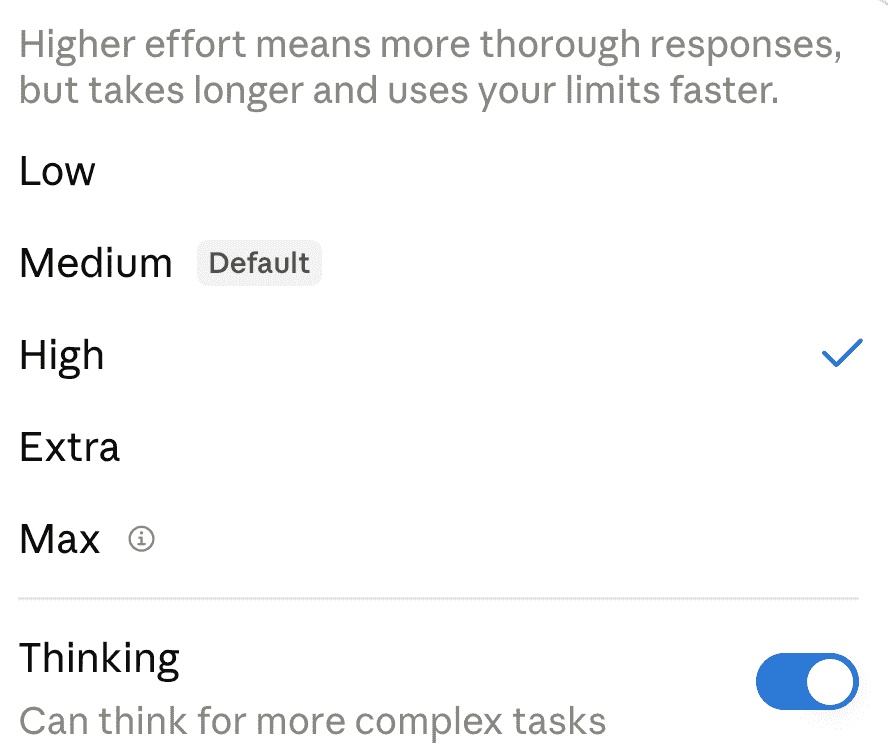
- It allows you to increase or decrease the model's reasoning without changing to a different model.
- Adjusting the reasoning effort is often more cost-effective than switching to a more advanced model such as Opus or Fable.
- It is recommended to experiment with the reasoning effort setting before moving to a higher-tier model.