

Bookkeeping and Accounting together refer to the process of recording, classifying, summarizing, and analysing financial transactions of a business to find out its profit or loss and financial position. Although they are related, they are not the same.
- Bookkeeping records daily financial transactions.
- Accounting uses these records to prepare financial statements and make decisions.
- Both work together to ensure the smooth running of a business.
Bookkeeping
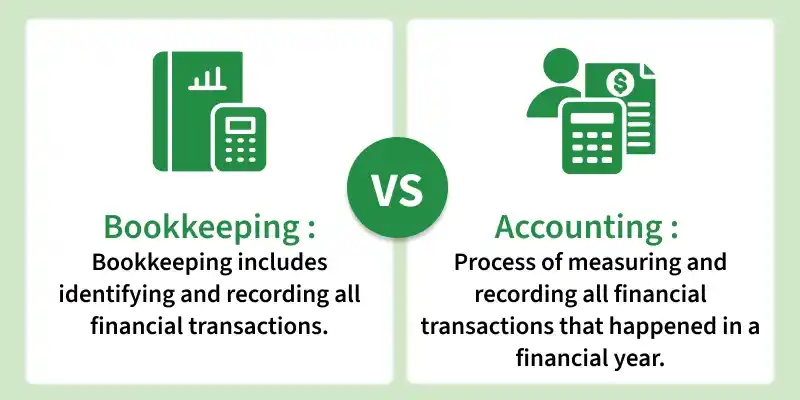
Bookkeeping can be defined as the proper and systematic maintenance of the books of accounts. It is the science and art of identifying and recording accounting transactions in a systematic way . It is concerned with the proper maintenance of the books, i.e., Journal, Ledger, Cash Book, and other subsidiary books. bookkeeping does not involve analysing or interpreting the results of a business; it focuses only on accurate recording.
Accounting
Accounting is the process of measuring and recording, summarizing, analysing all the financial transactions of business during the financial year. It helps in getting a clear picture of the financial position of the business by showing value of assets and liabilities .
Accounting is guided by many different rules, principles and standards, which are needed to be followed to obtain the required information for the decision-making process.
Difference between Bookkeeping and Accounting-
| Basis | Bookkeeping | Accounting |
|---|---|---|
| Definition | Identifying and recording all financial transactions | Measuring, summarizing, analysing, and interpreting financial transactions |
| Objective | To record all transactions | To record, analyse, and interpret transactions |
| Scope | Limited scope | Wider scope compared to bookkeeping |
| Decision Making | Does not help in decision making | Helps in decision making |
| Analysis | Only records information; no analysis | Analyses data to gain business insights |
| Skill Required | Knowledge of recording transactions accurately | Knowledge of accounting rules, principles, and standards |
| Financial Position | Does not show financial position | Shows profit, assets, and liabilities |
| Complexity | Simple process | More complex process |
| Level of Work | Clerical, low-level work | Involves all management levels |
| Supervision | Does not supervise accountant | Accountant supervises bookkeeper |