A Not-for-Profit Organisation (NPO) is established to provide services to society rather than earn profits. Examples include clubs, charitable trusts, educational institutions, hospitals, religious organisations, and libraries. NPOs prepare a Receipts and Payments Account, Income and Expenditure Account, and Balance Sheet. Certain receipts require special accounting treatment because they may be either capital or revenue in nature.
This chapter explains the accounting treatment of:
- Admission or Entrance Fees
- Donation and Legacies
- Grants from Government
- Sale of Fixed Assets
- Life Membership Fees
1. Admission or Entrance Fees:
Admission or Entrance Fee is the amount charged by a Not-for-Profit Organisation (NPO) from a new member at the time of admission, in addition to the annual subscription fee. This amount is paid only once by a member to become a member of the organisation. The accounting treatment of Admission or Entrance Fees depends on the policy of the organisation and the nature of the receipt. It may be treated either as a Capital Receipt or a Revenue Receipt
Accounting Treatment:
A. When treated as a Revenue Income: Some organisations treat Admission Fees as Revenue Income because, although each member pays it only once, new members join every year and the organisation receives this income regularly. In such cases, the amount is credited to the Income and Expenditure Account
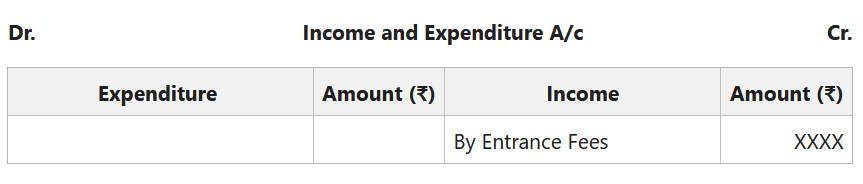
Illustration:
During the year 2021-2022, Entrance Fees received ₹3,20,000.
Solution:

Note: Admission or Entrance Fees without any specific information shall be treated as a revenue receipt and be shown on the credit side of the Income and Expenditure Account.
B. When treated as a Capital Receipt: If the organisation considers the Admission Fee as a one-time payment made by each member for obtaining membership, it is treated as a Capital Receipt. In this case, the amount is not credited to the Income and Expenditure Account but is added directly to the Capital Fund in the Balance Sheet.
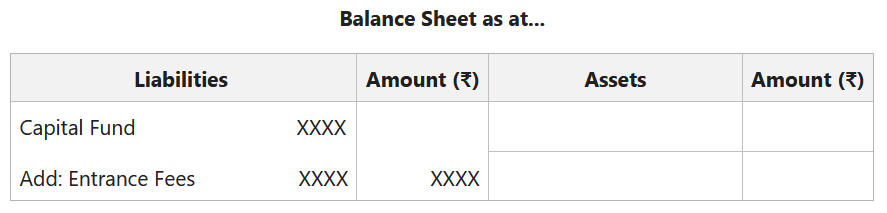
Illustration 2:
During the year 2021-2022, Entrance Fees received ₹3,20,000. It shall be treated as a Capital Receipt. The capital fund stood at ₹10,00,000.

2. Donation:
A donation is a voluntary contribution made by members or outsiders to a Not-for-Profit Organisation (NPO) without expecting any benefit in return. Donations are received to support the activities and objectives of the organisation. Donations are classified into the following two categories:
Specific Donation: When the donation is made and used for a specific purpose is it called a Specific donation.
Examples:
- Donation for Building Fund
- Donation for Library Fund
- Donation for Sports Equipment
- Donation for Tournament or Scholarship Fund
General Donation: General donations are used for the general activities of the Organisation. General donations can be of both recurring and non-recurring nature. When such donations are received in a big amount, it is treated as capital receipt and non-recurring. Similarly, if the amount of donation is small, it is expected to be recurring in nature and is treated as a revenue income.
Accounting Treatment:
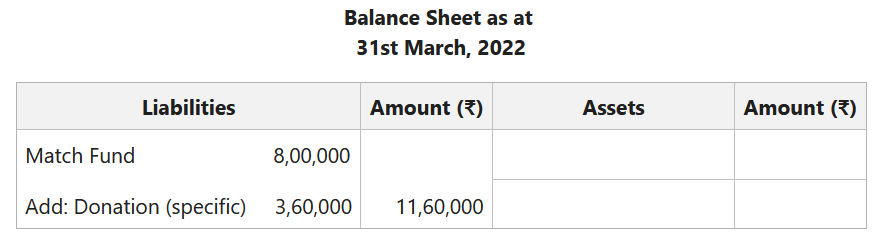
A. When the amount of Donation is either large or for a specific purpose:
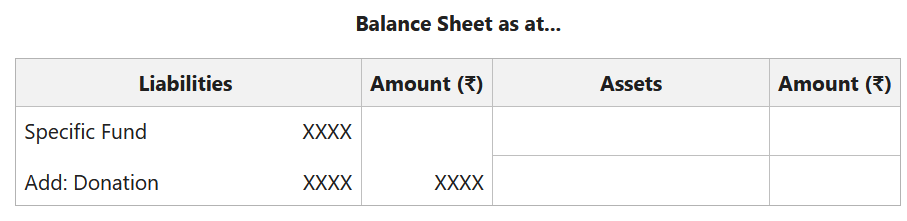
Illustration:
During the year 2021-2022, the donation for the sports fund received was ₹3,60,000. The sports fund was ₹8,00,000 at the beginning of the year.
Solution:
B. Small amount General Donation:

Illustration:
During the year 2021-2022, the donations received of ₹ 30,000.
Solution:

3. Legacy:
A Legacy is an amount or property received by a Not-for-Profit Organisation under the Will of a deceased person. Since it is generally received only once, it is considered a non-recurring receipt.
Accounting Treatment:
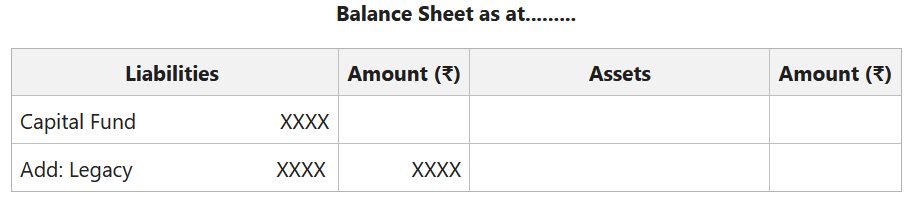
Illustration:
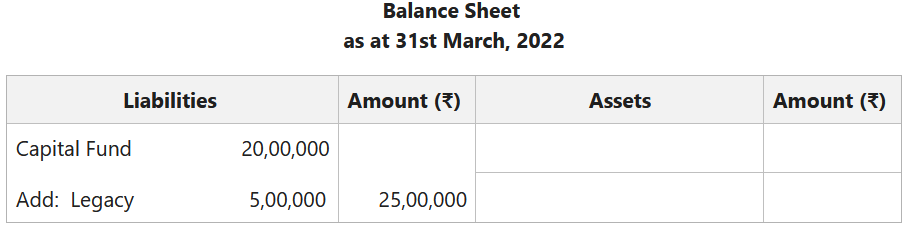
During the year 2021-2022, the organisation received a legacy of ₹5,00,000. The Capital Fund at the beginning of the year was ₹20,00,000.
Solution:
4. Grants from Government:
Grants from Government are financial assistance or transfer payments provided by the Central Government, State Government, or Local Government Authorities to a Not-for-Profit Organisation (NPO) for promoting social welfare and public service activities. These grants may be received for specific purposes or for meeting the general expenses of the organisation .
Examples:
- Government subsidy
- Government scholarship grant
- Grant for construction of a building
- Grant for purchase of equipment
- Maintenance grant
Accounting Treatment:
A. General Grants treated as a Revenue Income: It is received for meeting the routine expenses or general activities of the organisation

Illustration:
During the year 2021-2022, received a Government Grant of ₹25,000.
Solution:

B. Special Grants treated as a Capital Receipt: It is received for a particular purpose, such as the construction of a building, purchase of equipment, or any other specified activity
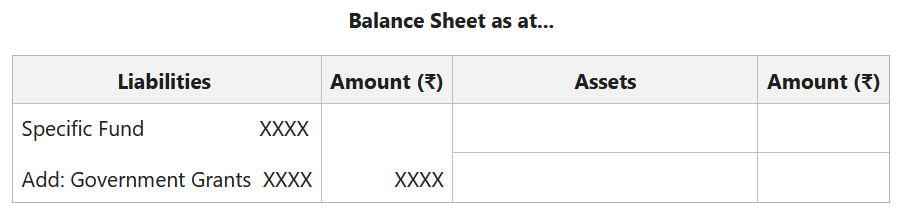
Illustration:
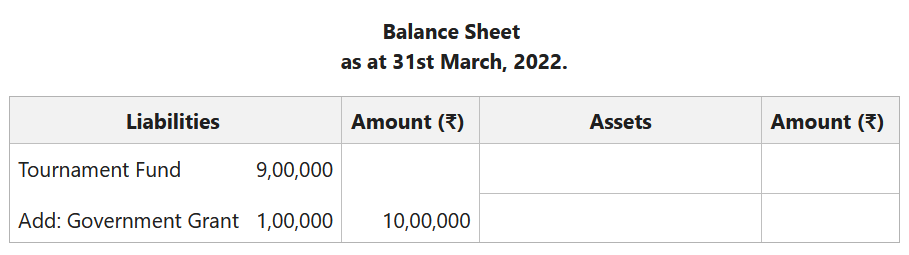
During the year 2021-2022, an Organisation received a Government Grant of ₹ 1,00,000 for organising a tournament. The Tournament Fund at the beginning of the year was ₹9,00,000.
Solution:
5. Sale of Fixed Assets:
A Sale of Fixed Assets refers to the amount received by a Not-for-Profit Organisation (NPO) from the sale of its fixed assets, such as furniture, buildings, machinery, equipment, or vehicles. Since the sale of fixed assets does not occur regularly, the amount received is non-recurring in nature and is treated as a Capital Receipt.
Accounting Treatment:

- On Profit of Sale of Asset:

- On Loss of Sale of Asset:


Illustration:
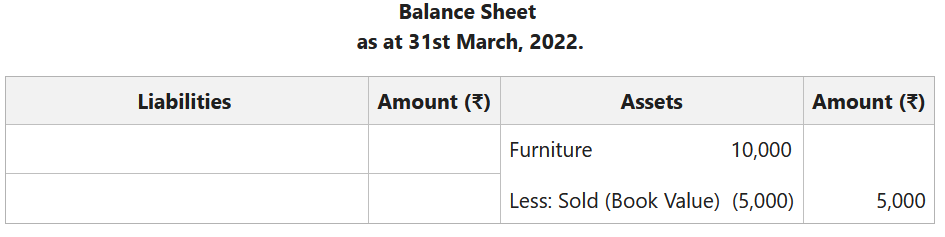
On 1.4.2021, a Club owned furniture of ₹ 10,000. Furniture of Book Value of ₹ 5,000 was sold for ₹ 3,000 during the year.
Solution:


6. Life Membership Fees:
Life Membership Fee is a lump-sum amount paid by a member of a Not-for-Profit Organisation (NPO) to obtain membership for life. Instead of paying the annual subscription every year, the member makes a one-time payment that entitles them to enjoy the benefits of membership for their lifetime.
Since this amount is received only once from a member, it is non-recurring in nature and is treated as a Capital Receipt.
Accounting Treatment:

Illustration:
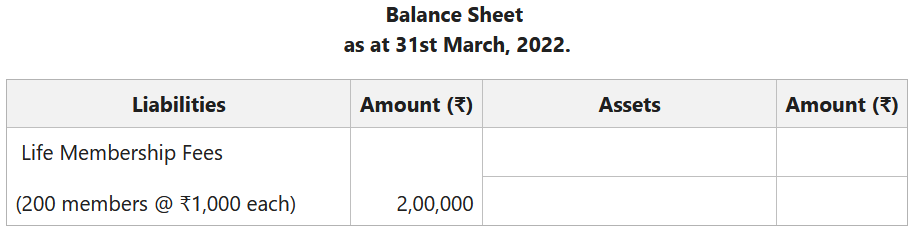
200 new members were added in the Club who paid a life membership fee of ₹1,000 each on 1.4.2021.
Solution: