

A share is a unit of capital or an equal portion of a company’s share capital, ownership of which is represented by a share certificate. In simple terms, shares are the divisions of a company’s capital. For example, if a company has a capital of ₹10,00,000 divided into 10,000 units of ₹100 each, then each unit of ₹100 is called a share. Shares are usually numbered for easy identification and are transferable in the manner prescribed by the Articles of Association. According to the Companies Act, 2013, “shares means shares in the share capital of a company and includes stock except where a distinction between stock and shares is expressed or implied
Forfeiture of Shares:
Forfeiture of shares refers to the cancellation of shares held by a shareholder who fails to pay the amount due on allotment or any call within the specified time. A company can forfeit shares only if its Articles of Association permit it, and it must follow the prescribed procedure. If the Articles do not mention the process, the company must give at least 14 days’ notice to the defaulting shareholder, requiring payment of the unpaid amount along with interest, and warning that failure to pay will result in forfeiture. Once forfeited, the shareholder’s name is removed from the Register of Members, and the amount already paid on the shares is retained by the company.
Re-issue of Forfeited Shares:
Re-issue of forfeited shares refers to the process by which a company sells back the shares that were previously forfeited due to non-payment by shareholders. After forfeiture, the company can reissue these shares to new or existing investors at a price determined by the board of directors, which may be at par, at a discount, or at a premium. However, any discount allowed on reissue cannot exceed the amount already received on the forfeited shares. Once reissued, the new shareholder enjoys all the rights attached to those shares, and the forfeited shares are treated as validly issued again.
Provisions related to re-issue of forfeited shares:
- Forfeited Shares can be re-issued at Par, Premium, or Discount.
- If the forfeited shares which were originally issued at par are re-issued at discount, the discount should not exceed the amount earlier received on forfeiture. And the discount will be debited to Share Forfeiture Account.
- If the forfeited shares, which were originally issued at a premium are re-issued, then the company does not need to record Securities Premium again on re-issue. However, if the company has not received the premium amount earlier, then it will record the amount on re-issue to the extent it is available. The shares which were originally issued at a premium may be re-issued at discount and are taken to the share forfeiture account.
- The balance of the share forfeiture account is a capital profit; hence, it will be transferred to the capital reserve.
- When a company re-issues only a part of the forfeited shares, then the profit made only on the re-issue will be transferred to capital reserve.
Journal Entries on Re-issue of Forfeited Shares:
1. When the forfeited shares are re-issued at par:

2. When the forfeited shares are re-issued at a premium:
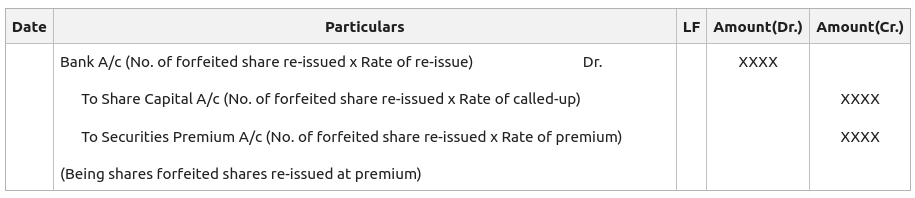
3. When the forfeited shares are re-issued at a discount which was originally not issued at discount:
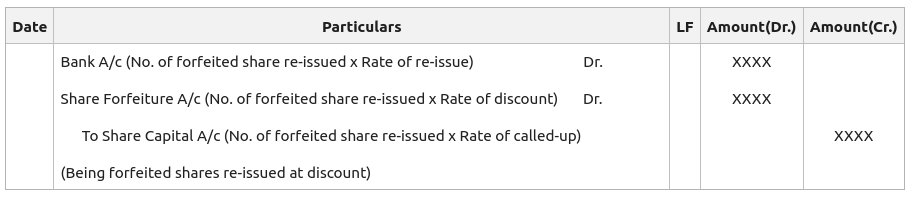
Share Forfeiture A/c will be debited with the amount of discount allowed on the re-issue of forfeited shares.
Transferring the Balance of Share Forfeiture A/c to Capital Reserve A/c:
Once the forfeited shares are re-issued, the credit balance left in the Share Forfeiture A/c must be transferred to Capital Reserve A/c. It is because this amount is a capital gain for the company.
The journal entry to be passed with the balance of Share Forfeiture A/c will be:

Note: If all the forfeited shares are not re-issued, then only the part of Share forfeiture A/c, which belongs to the re-issued shares must be transferred to Capital Reserve A/c, and the remaining balance of Share Forfeiture A/c will be shown in Notes to Account under the heading of Share Capital in the Balance Sheet.
Calculation of Capital Reserve on Re-issue of Forfeited Shares:

Re-issue of forfeited shares issued at par:
Illustration 1 (Re-issue at par):
Shreya Ltd. issued 50,000 shares @ ₹10 each payable as ₹4 on Application, ₹3 on Allotment, and ₹3 on First & Final Call. Radhika, who had been allotted 1,000 shares failed to pay the call money. Her shares were forfeited and re-issued at ₹10 per share as fully paid up. Pass the necessary Journal Entries in the books of Shreya Ltd.
Solution:

Illustration 2 (Re-issue at premium):
Vishal Ltd. invited applications for 20,000 shares of ₹10 each payable as under ₹3 on Application, ₹3 on Allotment, ₹2 on First Call, and ₹2 on Second & Final Call. The second & final call was not made by the company. An applicant who had been allotted 200 shares failed to pay allotment and first call money due. Those shares were forfeited after the first call and were immediately re-issued at ₹10.50 per share fully paid up. Pass the necessary Journal Entries in the books of Vishal Ltd.
Solution:

Illustration 3 (Re-issue at discount):
Vanshika Ltd. was registered with an authorised capital of ₹5,00,000 divided into shares of ₹10 each. The company invited applications for 30,000 shares payable as ₹3 on Application, ₹3 on Allotment, ₹2 on First Call, and the balance on the Second & Final Call. Astha, who had been allotted 500 shares failed to pay both calls. Her shares were forfeited and re-issued at ₹9 per share to Ambika, as fully paid up. Pass the necessary Journal Entries in the books of Vanshika Ltd.
Solution:

Re-issue of forfeited shares issued at premium:
Illustration 4 (Re-issue at par):
Shubham Ltd. issued 50,000 shares of ₹10 each at a premium of ₹2 payable as ₹4 on Application, ₹4 on Allotment (including premium), ₹4 on First & Final Call. All the shares were duly received except on 1,000 shares for First & Final Call money. These shares were forfeited and re-issued @ ₹10 each as fully paid. Pass the necessary Journal Entries in the books of Shubham Ltd.
Solution:

Note: Securities Premium Reserve A/c has not been debited at the time of forfeiture of shares because the premium has been already received with allotment money.
Illustration 5 (Re-issue at premium):
Tarun Ltd. issued 5,000 shares o ₹100 each at a premium of ₹10 each payable as ₹30 on Application, ₹40 on Allotment (including premium), and ₹40 on First & Final Call. All the money was duly received except Allotment and First & Final Call on 100 shares. These shares were forfeited and re-issued immediately @ ₹105 each. Pass the necessary Journal Entries in the books of Tarun Ltd.
Solution:
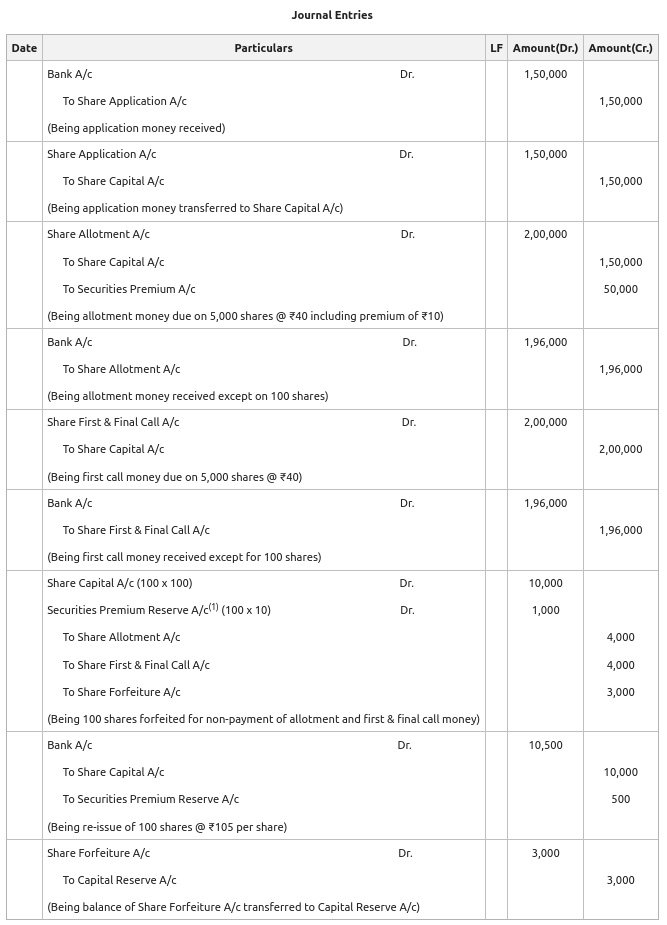
*1 In the above question, the allotment money on 100 forfeited shares has not been received and as the premium was also due on the allotment, it has not been received. Therefore, Securities Premium Reserve A/c has been debited at the time of forfeiture of shares.
Illustration 6 (Re-issue at discount):
Kashish Ltd. issued 1,000 shares @ ₹100 each at a premium of ₹20 payable as ₹30 on Application, ₹50 on Allotment (including premium), ₹30 on First Call, and ₹10 on the Second & Final Call. The company did not call the second & final call. All the shares were duly received except the First Call on 100 shares. These shares were immediately forfeited and re-issued at ₹80 each. Pass the necessary Journal Entries in the books of Kashish Ltd.
Solution:
